Wednesday, 15 January 2025

Arctic-class E-skip opening overnight Jan 13-14, 2025.

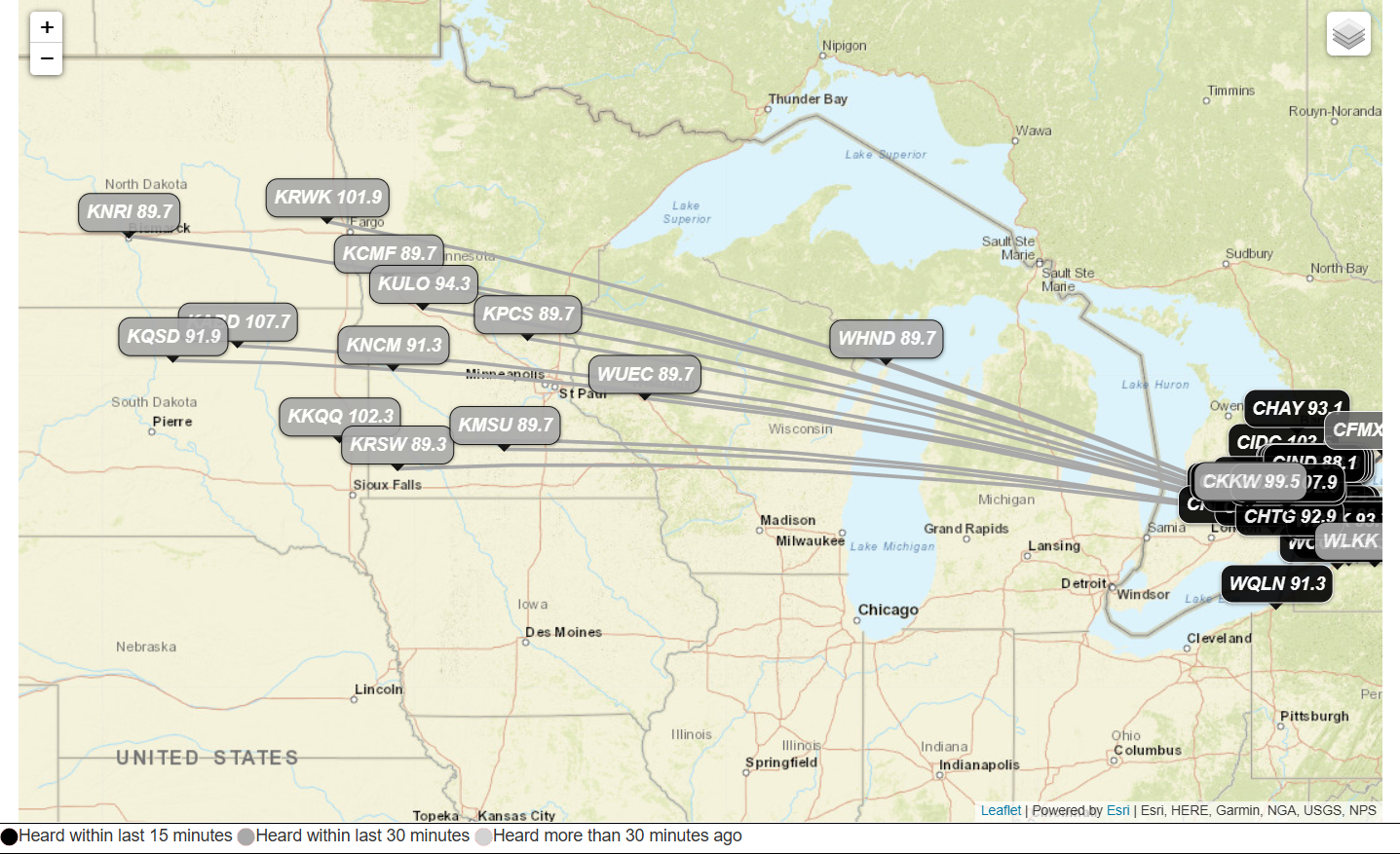
Rare January late night E-Skip opening Jan 14, 0034-0225 EST. From ND-SD-NE-MN-WI > ON.


One new FM catch : KABD 107.7 Ipswich SD. Also one FM via new mode : WHND 89.7 Sister Bay WI at only 399 miles (previous via TR). Missed it live, but the autologgers captured it.

Wednesday, 20 December 2023

10m : Lithuania & Newfoundland


Lithuania


LY3BFH Vilnius, Lithuania on 28.68 MHz adds another country to the 10-metre logbook.


Newfoundland & Labrador


VO1SW Gander, Newfoundland on 28.68 MHz adds another sub-country.


Saturday, 9 December 2023

 10m : Western Cape


ZS1KC Cape Town, South Africa on 28.68 MHz adds another sub-country to the 10-metre logbook.


Wednesday, 18 October 2023

10m : Saxony-Anhalt + Tula

Two new sub-countries received on 28.68 MHz SSTV during the past few days :


SAXONY-ANHALT 

And ... 

Monday, 21 August 2023

Great tropo opening continues - switches to the northwest.

 Tropo summary part 2 - for Aug 20-21 opening towards South Dakota.


miles
874 - WXM-41 162.425 South Shore, SD
824 - KNCM 91.3 Appleton, MN
724 - WNG-676 162.525 Clearwater, MN
693 - WFTC 29 Minneapolis, MN
517 - WDEZ 101.9 Wausau, WI

QTH - West Niagara, ON


Sunday, 20 August 2023

Big Tropo Opening TN > ON on August 19-20, 2023

 A quick summary of my 500+ mile catches during the Aug 19-20 Tr opening. This was my 1st-ever Nashville TV opening :

miles
776 - WPGF 87.75 Memphis TN
719 - WWH30 162.500 Dyersburg TN
650 - KXI42 162.450 Chester IL
638 - WDDJ 96.9 Paducah KY
631 - WXM49 162.425 Marion IL
628 - WCVQ-HD 107.9 Fort Campbell KY
626 - WKRN 27 Nashville TN
613 - WUXP 21 Nashville TN
605 - WNKJ 89.3 Hopkinsville KY
591 - WXN74 162.500 Hickman TN
589 - WXJ91 162.525 Madisonville KY
556 - WKDQ 99.5 Henderson KY
542 - WNG732 162.450 Lafollette TN
510 - WDCL 89.7 Somerset KY
508 - WULF 94.3 Hardinsburg KY

QTH = West Niagara, ON.

Emoji

Friday, 17 September 2021

NAVTEX Frequency Pollution from Canada

Canada's telecommunication authority - ISEDC - continues to allow CHLO-HD 530 Brampton, ON to create destructive interference to the 518 NAVTEX frequency in the form of a digital IBOC sideband covering 515-520 kHz. 

This electromagnetic pollution is in total disregard for the principles of GMDSS and ITU spectrum obilgations.


Friday, 23 July 2021


 Nicaragua TV double-hop

YNFA-302 Channel 2 Managua 

YNFA-304 Channel 4 Managua

                 Channel 3 Matagalpa


A 4-hour long double-hop sporadic E-skip event on July 22, 2021 brought TV signals from Nicaragua into Canada. Channel 2 Managua was first noted at 3:01 p.m. EDT. This was followed by the stronger Channel 4 Managua at 3:15 p.m. with a Multinoticias logo. Later the station returned to its usual '4' logo. YNFA-304 was in colour at times. A new catch, 1 kW Channel 3 Matagalpa was seen at 4:34 p.m. This repeater station was // to channel 4. The Nicaraguan signals managed to stick around until ~ 7 pm.

Seen here is a recording of Channel 4 Managua. This video uses frame-stacking, which although causes motion blur, increases the sharpness of still objects. The audio change partway through is a result of changing from NFM to WFM.


Thursday, 15 July 2021

 Colombia TV double-hop

5JA-5166 Channel 4 Santa Marta + 

5JA-8295 Channel 3 Sierra Nevada de Santa Marta +

5J...          Channel 3 Monteria


A long lasting double-hop sporadic E-skip event on July 13, 2021, that also brought in TV from Dominicana and FM from Puerto Rico, allowed reception of Colombia on channels 3 and 4 from here in Canada. The first sign of Colombia came at 4:24 p.m. EDT with relog Channel 4 Caracol Te Ve in Santa Marta. This continued until 5:09 p.m. when a new catch was seen, Channel 3 Caracol Te Ve in Sierra Nevada de Santa Marta (near Valledupar) // to Channel 4. Later on at 6:38 p.m., another new catch on Channel 3 with Telecaribe in Monteria. The Colombian opening lasted well over 2 hours.

Seen here are recordings of Channel 4 Santa Marta and Channel 3 Monteria.


 Puerto Rico FM into Canada !


WRTU-FM 89.7 San Juan at 1,891 miles on July 13, 2021


On July 13 during a double-hop E-skip event where Dominicana and Colombia were coming in on lowband TV, Puerto Rico appeared on the FM dial at 5:08 p.m. EDT, a new FM country for me (#8). The recording below begins at 5:27 p.m. Unfortunately my antenna switch wasn't pushed over completely, so the signal was about 10 dB lower than it could of been. Amazing strength for double-hop. Midpoint was in the Atlantic Ocean. 

Also received was an unID Spanish station on 97.1. No matches could be found in Puerto Rico, so Dominicana is suspected. 


Friday, 9 July 2021


 Trans-Atlantic FM DX into Ontario !

87.7 Azores confirmed - 2,816 mile double-hop

It took some investigation, podcasts, and a mix-up with Azores vs. Portugal time zones, but I managed to confirm reception of 87.7 RTP-3 Ponta Delgada, Azores (Pico de Barrosa xmtr) here in Grimsby, ON at 6:38-6:40 p.m. EDT July 8th. Top-of-the-band skip to Newfoundland was in at the time.

According to the schedule, the program 'Indiegente' was on at the time. (The podcast was found here : https://www.rtp.pt/play/p257/e556841/indiegente ). Recorded here are the few snippets of reception followed by clips from a podcast of the program.

My QTH is Grimsby, Ontario, Canada. Receiver : Icom R-8600 w/SDR Console. Antenna : CM-3671. no preamp.  
Update : As far as I know, this is officially a new North American FM DX record!
Note : The blank recording has been fixed.

Monday, 25 July 2016

40 Years of TV DXing

It was 40 years ago this morning that I started my bizarre hobby of trying to get distant TV stations on our antenna (in Niagara Falls, Ontario). Now after getting 1,086 stations from 9 provinces, 38 states and 15 countries, that keen interest still carries on.

The day before July 25, 1976, I decided I was going to get up early every morning and check the TV for distant stations. I had dabbled in TV DXing before, looking for those stations in the TV Guide that we never watched (or couldn't seem to get) as early as 1969, at the age of 6. I found my first "unlisted" station that same year, WICU 12 Erie, Pennsylvania, and then my first "real" DX in 1972 with WTOL 11 Toledo, Ohio. But now, this was going to be organized and I was going to keep a log.

WTOL had been my stagnant record for 4 years. That first morning, I was determined to find something equal or farther away. Luckily, conditions were favourable. I found a station battling with my semi-local Channel 6 Paris, ON, it ended up being WTVN 6 Columbus, Ohio. At a distance of 298 miles, I had already beaten my old record on the very first day. I was pumped wondering what I would get next.

On the 3rd day, in the evening at 6:29 p.m., I was totally blown away when I found a strong signal on Channel 3 that was showing the weather for Florida! That was crazy. It was in colour and easily watchable. It was WEAR Pensacola. Wow, how was this even possible? Florida? How come I couldn't get anything in between? Where was Ohio? Where was Tennessee? Why just one lonely station? My dad saw it too when he came to watch the news. He was impressed enough to tell the guys at work about it (but he also wanted me to change the channel, but relented).

Little did I know that what I saw was "sporadic E-skip", an unpredictable ionospheric propagation mode that was more like what you came across nightly on AM radio than on TV. I didn't find out about E-skip until I got hold of a brochure from the WTFDA (Worldwide TV-FM DX Association) in early 1977. I joined then and have been a member ever since.

WEAR-TV would turn out to be the only skip station I saw that summer. My tropospheric DX extended in all directions, with my best catch ending up being WOTV Channel 8 Grand Rapids, Michigan at 325 miles.

The next year, 1977, opened up the brand new world of E-skip DXing. By the end of that summer I was already up to 6 provinces and 20 states. I was hooked; and have been ever since.

Catches over the years can be found here... http://dxinfocentre.com/hepburn/tv_dx_vhf-lo.html


Friday, 10 June 2016

1st Trans-Atlantic E-Skip

It wasn't on TV or any of the other broadcast bands, but I'm still happy to receive my first Trans-Atlantic VHF signal yesterday via E-Skip mode rather than F2 Skip. It was also my first VHF DX from Africa.

The station received was EA8DBM Tenerife, Canary Islands, a ham station transmitting CQ and QRA messages on 50.1 MHz in Morse Code. Time of reception was 1:48 p.m. EDT. The distance of 3,591 miles broke my old record of 2,491 miles to TV Channel 4 Trinidad.

Thursday, 9 June 2016

Another odd-ball TV station

While we're on the topic of strange-acting analogue TV carriers, I found another one yesterday during an E-skip opening. So far it's a UTV (unidentified television station) as I could not get any discernible video. It really is odd as the carrier seems to FM-modulate then narrow again. It was on channel 5z. Time of reception : 9:28 p.m. EDT. The signal seemed to peak west. Openings to Nebraska-Kansas, Manitoba and Alabama were active at this time. Target Area: Missouri ?

Spectrum capture and audio version are below :


Audio of video carrier.

Sunday, 5 June 2016

CITO-TV 3 Timmins turns into a police car

This morning fellow DXer Ed Phelps in Kentucky reported hearing an analogue TV video carrier on channel 3+ that sounded like a police siren. Intrigued, I checked and found it too.

It appears to be CITO-3 Timmins, Ontario. At a distance of 376 miles, I can normally see the carrier from this station, and occasionally hear the audio. This morning the signal was enhanced. What you see below is a screen capture. At 61.25 you can see regular CICI1 Elliot Lake. At 61.26 you can see the misbehaving CITO carrier.


It really does sound a police siren, especially when off-tuned. The first audio file below is the sound of the carrier in USB. The second file is the carrier off-tuned.

CITO video carrier

CITO off-tuned video carrier

Now Ed Phelps is 878 miles from this station. He is likely receiving it via meteor scatter mixed with some lingering ionoscatter. Mike Bugaj in Connecticut also reports hearing the signal.

CITO's actual FM audio on 65.76 does sound normal, by the way.

For how long will CITO be an unintentional police siren alerting DXers of its presense for hundreds of miles around?


Sunday, 27 July 2014

9th Province via TV

On July 15th, I finally managed to pick up Prince Edward Island on TV via sporadic E-skip to bring my provincial total up to 9 - leaving just one more to go (British Columbia) to complete all 10. 

Due to its small size, PEI has always been a difficult VHF DX target. This isn't the first VHF DX received from PEI. I've previously heard PEI on FM in 2012, and prior to that the VOR air navaid at Charlottetown - YYG on 113.8 MHz - received back on July 22, 1995. 

I've been trying to get PEI on TV for a while now, and especially since the US digital transition in 2009. There were 2 lowband targets left in 2009 - both in the community of St. Edward and both analogue : CBCT-1 (CBC) on the now-empty channel 4 and CKCW-TV-2 (CTV) on the still-occupied channel 5 (by local CBLT Toronto). CBCT1 was shutdown by the CBC in 2012, so it was no longer a target. That left just CKCW2, but at least by then channel 5 had been vacated by Toronto. Once CKCW2 shuts down, the only remaining TV stations in PEI will be digital on channels 8, 13 and 42. Channel 8 is not impossible by E-skip or tropo - but not very likely.

What has made CKCW2 so elusive for the past couple of years has been the fact that channel 5, despite being much "emptier", is still occupied by CHRO Pembroke, Ontario. Although it is 218 miles away, it's received 24/7 - at least the audio is. CHRO and CKCW2 are on the same offset (+) and also in the same general direction. The distance to St. Edward is 793 miles.   

The morning of July 15th started off with a lowband TV opening into the Southern US. Just after 11 am, an opening to the Maritimes appeared that soon moved up into the FM band. At 12:53 PM EDT, I finally heard some audio on 5+ (81.76 MHz) punch through CHRO. It was an ad for a "Wiggles" tour with stops in Halifax, Saint John, etc. Definitely a Maritimes station. Luckily fellow CTV Atlantic station CJCB channel 4 Sydney, Nova Scotia was also in at the same time, so I could confirm that they were parallel. Finally PEI had been received on TV! Unfortunately the video was never strong enough to punch through CHRO, although it gave a good fight with strong CCI.


Thanks to the Wiggles, an Australian childrens music group, PEI was entered into the TV logbook.

  Picture © 2014 Ticket Atlantic.

TV DX PROVINCES

1  ON  1967             CBLT   6  Toronto
2  QC  1976-08-03-06..  CBOT   4  Ottawa, ON
3  SK  1977-06-05-2111  CKCK2  6  Willow Bunch
4  MB  1977-06-06-2159  CBWFT  3  Winnipeg
5  NB  1977-07-07-2145  CKCW   2  Moncton
6  NS  1977-07-07-2145  CBHT   3  Halifax
7  NL  1988-06-27-2158  CJCN   4  Grand Falls
8  AB  2013-07-03-2012  CHAT1  4  Pivot
9  PE  2014-07-15-1253  CKCW2  5  St. Edward

Thursday, 24 July 2014

DXing near the North Pole

As my first blog, I thought I'd reissue something that I wrote back in 1997 but is still of interest. It was written in response to Kevin Redding who asked what DXing was like during my time living in Canada's High Arctic (Nunavut, ex-NWT). I originally posted it on the AMFMTVDX forum. Here it is...

Kevin, I lived in the NWT from Aug. '82-Aug. '85 - in 4 different locations (while working as a young punk at the wx stations)...

Eureka (Ellesmere Island)
 80-00 N 85-49 W  Civilian Wx station (pop. 9)
Resolute Bay (Cornwallis Island)
 74-43 N 94-58 W  High Arctic hub & Inuit village (pop. 170)
Hall Beach (Melville Peninsula)
 68-46 N 81-14 W  DEW-line site & Inuit village (pop. 350)
Coral Harbour (Southampton Island)
 61-12 N 83-22 W  Inuit village (pop. 430)

At 80°N, Eureka is further north than the most northern Inuit village (Grise Fiord). Unfortunately, I didn't have a proper DX setup; doing a lot of DXing on a "ghetto-blaster" inside a metal-encased building !!! (Compared to other portables, I now find the receiver, a JVC PC-R11C, to be below average on AM).

In Eureka, we had a 4.5 month dark winter, a 4.5 month lit summer, and a 6-week long spring & fall. There was one "local" AM station when I first got there in August of '82 - it was AFRS-1430 Thule, Greenland. It was about 350 miles away and could be heard 24-hrs a day. A month later, it left the air & moved to FM. We had lost our "favourite" (and only) station! Otherwise, the closest AM station was 990 Qaannaaq, Greenland at 300 miles which faded in & out.

After AFRS left AM, we were left without a source for new music. With 24-hour sunlight, the AM band was basically dead. Sometimes KBRW-680 Barrow, AK (1,300 miles) would come in, but it was a boring station. The "local" CBC station, 1230 Frobisher Bay (1,200 miles), could not be heard in daylight. We had a satellite dish, but it was only hooked up for TV. Actually, the TV station was 7 miles away at Skull Point where the dish was. Eureka is in the middle of mountains - the south was blocked off. At Skull Point, the south can be seen. The elevation angle of the dish is 0.5 degrees - nearly horizontal! An unlicensed 1-watt transmitter on Channel 9 (still the world's most northern TV station) broadcasts from Skull Point, which we picked up in Eureka using a simple yagi. The satellite channel could be changed from our site by remote control.

Anyways - back to AM. We had no source for music, so KYOI-Shortwave Saipan became "our" station. If you remember, KYOI was a commercial music station on shortwave broadcasting in Japanese & English from a studio in Los Angeles.

In the winter, the AM band went nuts. In the evening, we used to listen to Radio Luxembourg on 1440. Back then it was in English from studios in London. "R-T-L 2-0-8" is still my all-time favourite radio station. It was so lively with excellent DJs. Some evenings they'd play the Top-20 countdown from the UK, some nights the US countdown. It came in loud & clear on 1440 between 8 PM - 11 PM until it faded & CFGO Ottawa took over. Sometimes, Saudi Arabia would come in on 1440 and create a nuisance. Luxembourg wasn't the strongest European signal though, that honour went to 1314 Norway hands down.

So after 11 PM, the Eastern North Americans would take over; then after 2 AM, the Western guys would come in. Meanwhile the Alaskans would be in most of the night. KJNP-1170 North Pole was by far the strongest Alaskan. KICY-850 Nome was always an interesting station. I never did hear Japan though. Novosibirsk did come in on 1026. Occasionally Caribbean stations such as 1580 Antigua came in. Oh yeah, regarding Mexico City, from Resolute Bay I have XEW listed as my only entry on 900!

The graveyard channels were empty, so stations such as CJOK-1230 Fort McMurray, AB (about 2,000 miles) came in loud at times without any QRM, later in the night when Frobisher Bay & Churchill were weaker.

As far as the Europeans go, the part of the band above 1000 was definitely better. Here were the stations heard most often :


  • Greenland   570 , 650 , 750 , 850 , 990
  • Albania   1395 , 1458
  • Austria   1476
  • Belgium   1125
  • England   1053 , 1089
  • France   164 , 1350 , 1377
  • Germany   185 , 1017 , 1044 , 1197 , 1269 , 1422 , 1539 , 1593
  • Luxembourg   1440
  • Norway   1314
  • Northern Ireland   1341
  • Poland   1503
  • Saudi Arabia   1440
  • Soviet Union   236 , 1026 , 1143 , 1323 , 1566
  • Sweden   1179
  • Yugoslavia   1413
Now, the most bizarre AM happening that I had in the Arctic had to be in Hall Beach. I arrived there in Feb. '84. With 24-hr dark, I was expecting lots of AM stations. Would you believe the band was dead! In fact the band was dead all the way through February until I left in July! The ONLY station heard was CFFB-1230 Frobisher Bay. It didn't matter whether I was inside, outside, at the wx station - all AM radios were dead. When I came back in September, the band was going nuts with stations at night! Could this be explained by the "auroral-doughnut" or whatever its properly called? Could Hall Beach be in the centre of it? Auroral displays were rare there, another clue?

No VHF DX was had in Eureka, Resolute or Hall. Hall Beach had 2 FM stations, one was the CBC on 106.1, the other was KMBR on 108.25 (ex-109.05)! It was a feed from KMBR-FM Kansas City. The CBC station is apparently unlicensed. It was the station on which I made my weather broadcasting debut, hi. It may have had the calls CHHB-FM.

In Coral Harbour, E-skip was had on both TV & FM from NF to AB, including the states of MI, WI, MN, ND, SD & MT. Most of the ES was between 11 PM - 1 AM CST indicating a likely link to auroral activity. There was only 1 local station - the CBC on 105.1.

So that's a bit of a rundown. I can only imagine what it would have been like if I had laid out a mile-long wire on the tundra and had my NRD-535D with me! Maybe someday I'll volunteer for a tour-of-duty some winter. I still remember those droning depressing "This is Radio Tirana" announcements and the Russian woodpecker sound shooting across the AM band!